Introduction
There is near consensus among academics and businesspersons that the Business Confidence Index (BCI) contains information about future investment growth owing to its predictive ability and superior forecasting power. The index serves as an early warning sign for the expected state of the economy, helping policymakers in predicting economic expansions, contractions, and turning points. Effectively, economic growth, economic stagnation, and, to some extent, economic recessions or crises can be foreseen with a reasonable degree of accuracy.
The Durban BCI is computed from quarterly survey data on business conditions and expectations. It is based on responses provided by business executives and entrepreneurs in the greater eThekwini Municipality. This report presents the Durban BCI for the second quarter of 2025. The index ranges from 0 to 100, where a score below 50 implies a lack of confidence in the Durban economy, a score of 50 indicates that the business situation is normal/neutral, and a score above 50 denotes confidence in the economy.
The Durban BCI
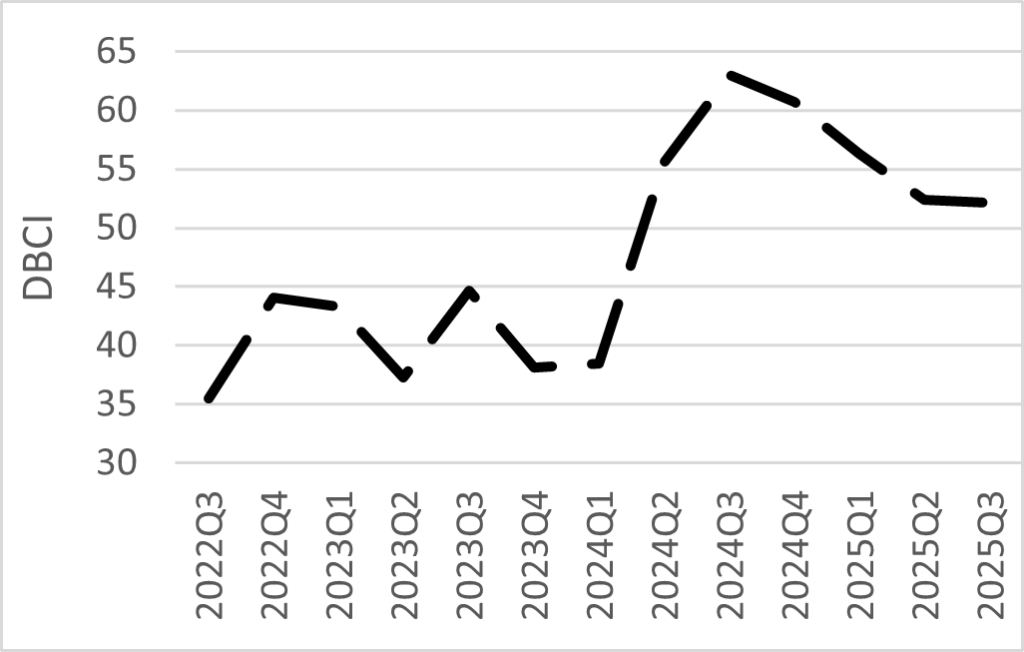
The Durban Business Confidence Index (DBCI) slipped for a fourth consecutive quarter in 2025Q3. It dropped by 0.53% from 52.40 index points in the second quarter of 2025 to 52.12 in the quarter under review (see Figure 1). This signals deterioration in confidence in the current and future economic conditions in Durban. The data further indicates that business executives were more pessimistic in the third quarter of 2025 than they were in the same quarter of 2024, with the index dropping by 17.38% on a year-on-year basis. While the DBCI shows a steady decline, it remains marginally above the neutral zone and noticeably higher than the national business confidence index. In the third quarter of 2025, the national BCI computed by the University of Stellenbosch dropped to 39 points from 40 index points in the previous quarter. Consequently, it appears that the drop in the Durban Business Confidence Index (DBCI) is largely driven by national economic conditions than Durban-specific factors.
Figure 1: The Durban BCI
The reported index hides non-negligible heterogeneities across the Durban economy. Industries such as the manufacturing, electricity, gas, and water-supply as well as the wholesale and retail trade, repair of motor vehicles, motorcycles, and personal and household goods, reported business confidence gains in the third quarter of 2025Q3 compared to the previous quarter.
After dipping to 41.82 index points in the second quarter, the manufacturing sector recorded a 23% improvement in business confidence, rising to 51.24 index points in the third quarter of 2025. This improvement coincides with an expansion in economic activity, resulting in robust demand and thus optimism in the manufacturing sector. Year-on-year, business confidence in the manufacturing sector shrunk by 19%. This suggests that while sentiments have significantly improvement in 2025Q3, they are worse than they were in the same quarter of 2024. Electricity, gas, and water also registered a significant improvement in the present quarter, although it remains below the neutral zone. Confidence in the sector was reported at 37.80 in the third quarter of 2023. This is consistent with the improved reliability of the national grid. Furthermore, optimism in the sector is reflected in the high volume of electricity production and consumption (SARB, 2025).
The decline in residential and non-residential buildings continues to erode business confidence in the construction sector, which was recorded at 37.80 index points in the third quarter of 2025, , 12.20 points below the neutral zone. In the Transport, Storage, and Communication Sector, confidence declined by 13.66% from 62.13 in the second quarter to 53.64 in the quarter under review. This is partly attributed to reduced activity in land and freight transport, fewer passenger transport trips, and a decline in auxiliary transport services (SARB, 2025).
Business confidence in the wholesale and retail trade, repair of motor vehicles, motorcycles, and personal and household goods sector improved by 15% in 2025Q3 compared to 2025Q2. In this sector, business confidence was reported at 57.08 index points in the third quarter of the present year, down from 49.63 index points in the previous quarter. This is partly ascribed to the lower inflation and consequently favourable interest rates.
Quarter-on-quarter (Q-o-Q), business confidence in the financial intermediation, insurance, real estate, and business services sector contracted by 7.77% in the third quarter of 2025. This follows a 2% decline in the previous quarter. Business confidence in the Community, Social, and Personal services sector diminished from 59.99 points in the second quarter of 2025 to 53.25 index points in the third quarter of 2025. This represents a 12.74% Q-o-Q change. On a year-on-year (Y-o-Y) basis, the sector recorded a 4% improvement in business confidence. This suggests that although conditions were worse in the third quarter relative to the second quarter of 2025, they are better in the present year compared to 2024.
In conclusion, the Durban BCI dipped by 0.53% in 2025Q3 to 52.12 index points from 52.40 index points in the previous quarter, representing a steady deterioration in economic conditions. Interestingly, the index remains above the neutral zone, indicating that investors remain confident in the City’s economic atmosphere. Comparing this with the national business confidence, we conclude that the decline in the City’s confidence is likely driven by dwindling conditions nationally more than factors that are specific to Durban. These factors including the ongoing geopolitical and trade uncertainties, and South Africa’s state of affairs (e.g., the weakening institutions, particularly the rule of law). These undermine the country’s (as well as the City’s) ability to attract investment.
Service Delivery
The opinion of business persons on service delivery worsened in the third quarter of 2025. A larger proportion of the respondents to the Survey of Business Opinion used to compute the Durban BCI for 2025Q3 (80% in 2025Q3 compared to 71.4% in 2025Q2) reported that if they (or anyone) complained about poor service delivery, it is unlikely that the local municipality would deal with it within a reasonable time frame. The businesspersons’ increasing dissatisfaction with service delivery in Durban is a cause for concern, may be partly responsible for the decline in the 2025Q3 Durban BCI, and underscores the need for the municipality to improve its service delivery and complaint handling mechanisms.
In the survey, the largest proportion of the respondents identified roads (27.1%) as the poorest service provided, followed by environmental management (sewerage, solid waste, and parks) (24.3%), water (18.6%) and public safety (police, fire and ambulance) (18.6%) and electricity (11.4%).
Review of Selected Macroeconomic Indicators
Real GDP
Revised figures show that annual growth of real gross domestic product (GDP) slowed down from 0.8% in the first quarter of 2025 to 0.6% in the quarter under review (see Figure 2). Q-o-Q, however, the country’s real GDP growth accelerated from 0.1% in 2025Q1 to 0.8% in 2025Q2. While the country recorded positive economic growth both Y-o-Y and Q-o-Q in 2025Q2, it is a cause of concern that real output in the country consistently grew at less than 1% throughout 2024 (both Y-o-Y and Q-o-Q), and the trend is continuing in 2025.
An International Monetary Fund Staff Report published in 2000 recommends that the country “needs to increase its potential growth rate … to above 6%, in order to help address its problems of high unemployment, poverty and extreme inequality in the distribution of income.” Clearly, the country is significantly below the recommended minimum growth rate, which does not inspire business confidence among industry leaders. During the 2025Q2, mining and quarrying grew by 3.7%, agriculture, forestry, and fishing by 2.5%, manufacturing by 1.8% and wholesale and retail trade by 1.7%, relative to the previous quarter.
Inflation and interest rates
Inflation rates, as measured by Y-o-Y percentage changes in the all items national composite consumer price index, rose from 3% at the end of the second quarter (June 2025) to 3.5 at the beginning of the third quarter (July 2025) before dropping to 3.3% in August 2025 (see Figure 3). The REPO rate, on the other hand, remained unchanged in April and May 2025 at 7.5% before being adjusted downwards to 7.25% at the end of the second quarter (June 2025). It was further adjusted downwards to 7% in August 2025 (see Figure 3). The general picture shows that while inflation rates have been fluctuating up and down below the mid-point (4.5%) of the targeted band (3-6%), the REPO rate has been consistently on a downward trend throughout the year.
In KwaZulu-Natal, inflation was recorded at 3.8% in July 2025, 0.3 percentage points higher than the national rate of inflation. According to Durban EDGE, “the primary driver was the Housing and Utilities category (+5.8%), followed by essential Food inflation (+5.3%).”
Exchange Rates
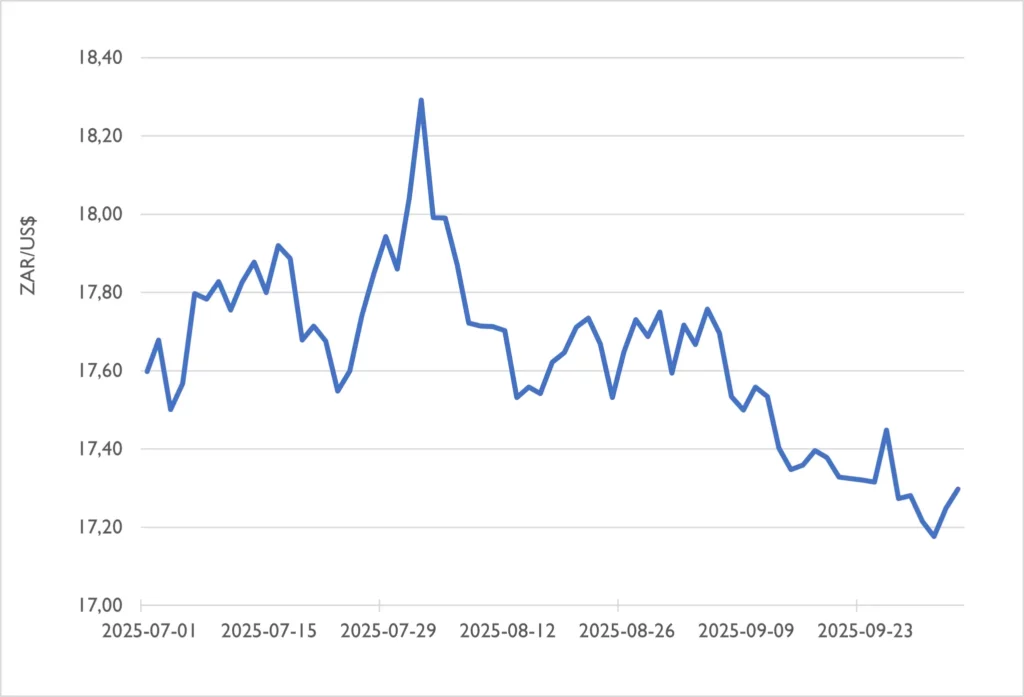
The South African rand (ZAR) gained strength against major trading currencies, albeit slightly, during the quarter under review. The rand marginally gained 2.86% against the United States dollar (US$), rising from ZAR17.7758/US$ at the end of the second quarter to ZAR17.2813 at the end of the third quarter (see Figure 4). The local currency also recorded marginal appreciations of 4.77% and 2.56% against the Pound Sterling (GBP) and the Euro, respectively, rising from ZAR24.3502/GBP to ZAR24.2408/GBP and from ZAR20.8323/Euro to ZAR20.3124/Euro, in that order.
Figure 2: South Africa’s annual real GDP Growth rates
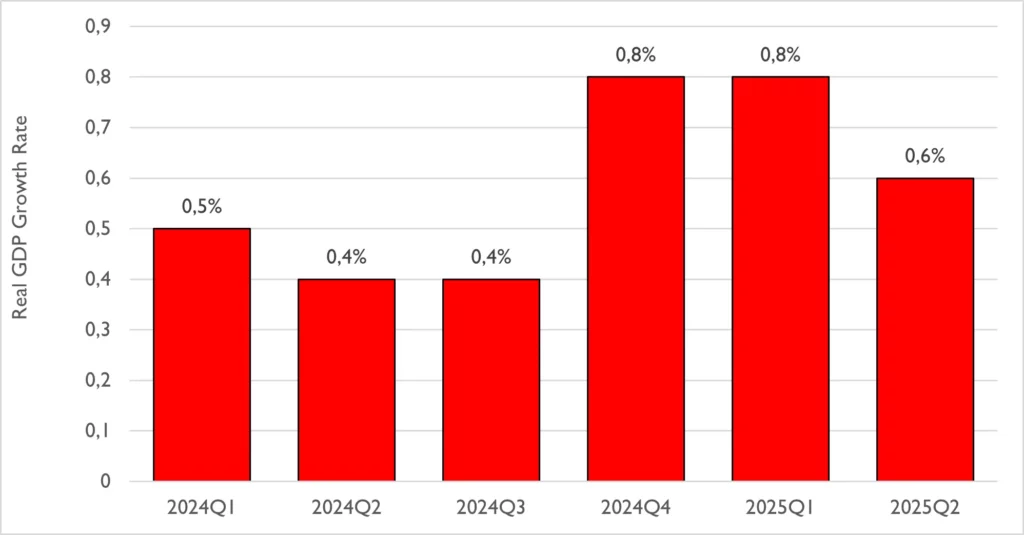
Figure 3: Inflation & REPO Rates
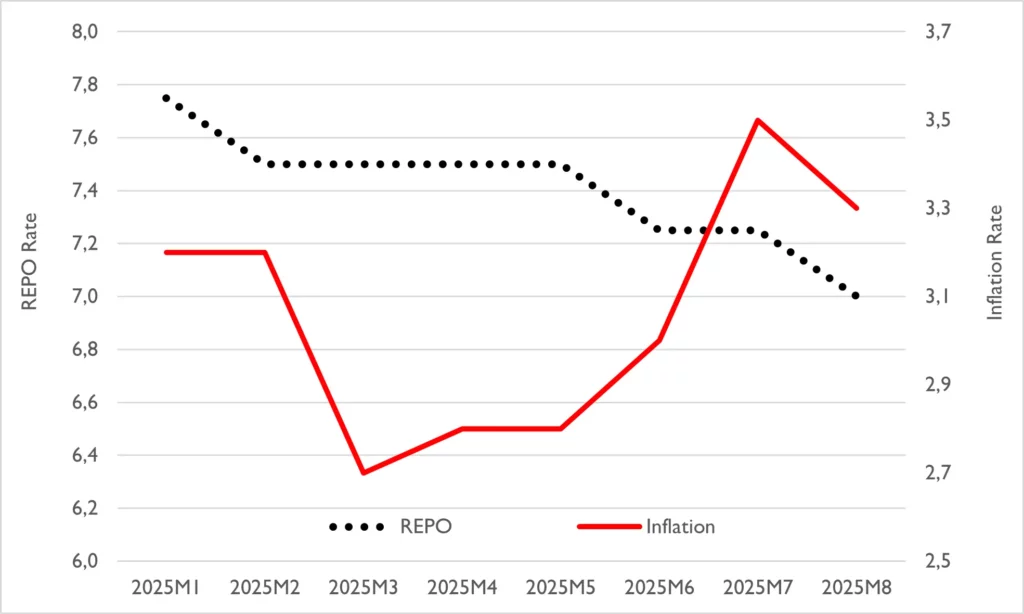
Figure 4: ZAR/USD exchange rates